News
Survey Shows Strong Support for Pope Leo XIV Ahead of His Visit to Spain
Strong Backing for Pope Leo XIV
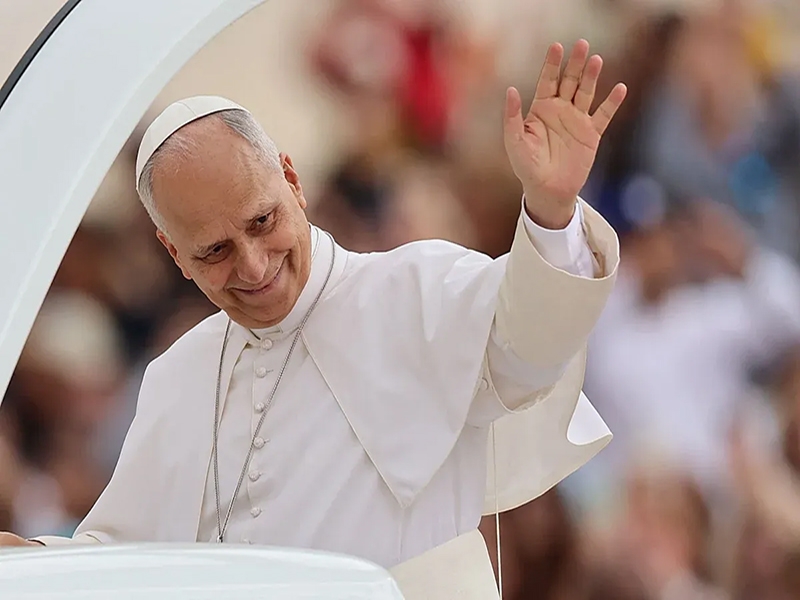
Pope Leo XIV
(Source: conelpapa press)
(Source: conelpapa press)
For readers unfamiliar with the organization behind the study, GAD3 —short for Gabinete de Análisis Demoscópico— is a Spanish consulting firm specializing in social research, public opinion analysis and electoral studies. Founded in 2001, it has become one of the country’s most influential polling and sociological analysis companies, with a regular presence in national and international media. Its president, Narciso Michavila, is a well?known figure in the field of electoral sociology, while the firm’s general director, Sara Morais, oversees its large?scale research projects. GAD3 is recognized for its statistical precision, its ability to manage extensive samples and its rigorous methodology, which explains its recurring role in major social analysis efforts.
The survey shows that parishes and religious communities have been the primary source of information for attendees: 52% learned about the visit through their local church environment, far ahead of the Pope’s official website (29%), family and friends (27%) or social media (25%). This community dimension is also reflected in how people plan to attend the event. Forty?one percent will travel with a religious group or association, while 33% will go with family members and another 33% with their parish. The pattern suggests a form of participation marked by shared identity and collective experience, a dynamic often seen in large?scale spiritual gatherings.
Accommodation plans among participants vary widely: 25% will stay with friends or relatives, 24% in schools, 20% in their own homes, 18% in hotels and 12% in parish facilities. As for transportation, buses will be the dominant mode of travel, chosen by 53% of respondents, followed by cars (27%) and trains (19%). The prevalence of group travel reflects the organizational habits of many parish communities, which often coordinate transportation to simplify logistics and reduce costs.
The motivations for attending combine spirituality, emotion and social connection. Sixty?nine percent say they participate as an expression of their faith, 62% seek to deepen their personal spiritual experience, 60% want to share the event with family or friends and 57% hope to see the Pope in person. Other significant motivations include the desire to feel part of a collective celebration (52%) and personal curiosity or interest (38%). Together, these reasons portray an event that goes beyond liturgy and becomes an emotional and communal experience, with the Pope’s presence acting as a central catalyst.
The emotions attendees expect to feel during the visit are equally revealing. Joy leads the list at 59%, followed by hope (53%), spiritual connection (47%), peace (44%), a sense of unity with others (33%), enthusiasm (20%) and pride (16%). The overall tone points to an experience marked by celebration, inner renewal and a strong sense of community —elements that often define major religious gatherings.
Respondents’ perception of Pope Leo XIV is clear. On a scale of 1 to 5, they rate him as clear (4.4) rather than confusing, close (4.2) rather than distant, more pastoral than institutional (3.8) and more modern than traditional (3.2 versus 5). The resulting image is that of an accessible leader, inclined toward dialogue and characterized by a contemporary pastoral style —a combination that appears to resonate with attendees’ expectations.
Respondents’ perception of Pope Leo XIV is clear. On a scale of 1 to 5, they rate him as clear (4.4) rather than confusing, close (4.2) rather than distant, more pastoral than institutional (3.8) and more modern than traditional (3.2 versus 5). The resulting image is that of an accessible leader, inclined toward dialogue and characterized by a contemporary pastoral style —a combination that appears to resonate with attendees’ expectations.
The topics participants most hope the Pope will address also offer valuable insight. Sixty?five percent want him to speak about youth and the future, 64% about family and life, 53% about education, values and religious freedom, and 38% about dialogue with those distant from the faith. Other issues mentioned include peace and international conflicts (32%), internal Church renewal (28%), poverty and social justice (25%), vocations (23%), migration and hospitality (17%) and the environment (7%). The hierarchy of concerns reveals a strong focus on youth, family and the transmission of values, well above sociopolitical or environmental matters.
Expectations regarding the impact of the visit are also significant. Seventy?four percent believe it will amplify the Church’s message, and another 74% think it will strengthen the sense of belonging among believers. Seventy percent say it will help spread the Christian faith, and 63% believe it will reinforce Catholics’ commitment to the Church. Only 28% think the visit will be used politically, and just 4% believe it will go largely unnoticed. These figures suggest an event that, in the eyes of participants, will have a profound effect both on the internal life of the Church and on their personal spiritual experience.
The report also includes a word cloud summarizing the messages attendees would send to the Pope. Among the most repeated terms are “hope,” “family,” “youth,” “truth,” “path,” “love,” “Christ,” “future” and “courage.” The collection reflects the emotional tone of the event: gratitude, a request for guidance and a desire for spiritual renewal.
The report also includes a word cloud summarizing the messages attendees would send to the Pope. Among the most repeated terms are “hope,” “family,” “youth,” “truth,” “path,” “love,” “Christ,” “future” and “courage.” The collection reflects the emotional tone of the event: gratitude, a request for guidance and a desire for spiritual renewal.
Liability for this article lies with the author, who also holds the copyright. Editorial content from USPA may be quoted on other websites as long as the quote comprises no more than 5% of the entire text, is marked as such and the source is named (via hyperlink).